

A HISTORY OF NIUE’S CONSTITUTIONAL DEVELOPMENT
19 October 1900 Niue Proclaimed a British Territory
11 June 1901 Niue formally annexed to New Zealand as part of the Cook Islands.
1904 Niue was made a separate administration with its own Resident Commissioner and its own Island Council appointed by the Governor General of New Zealand.
1960 The first Niue Assembly elected by Universal Suffrage was established with an elected representative for each of the 14 villages.
14 December 1960 The General Assembly of the United Nations adopted a resolution on colonialism in the following terms:
“Immediate steps shall be taken in trust and non-self-governing territories or all other territories which have not yet obtained independence, to transfer all powers to the people in those territories, without any conditions or reservations, in accordance with their freely expressed will and desire, without any distinction of race, creed or color, in order to enable them to enjoy complete independence and freedom.” New Zealand voted in favor of this resolution which therefore entail the early consideration of the future of New Zealand’s dependent territories, the Cook Islands, Niue and the Tokelau Islands.
Executive committee: Komiti Fakatufono – used as a political training ground for the future of Niue’s Constitution Development. One of the purposes of an executive committee would be to deal with matters which were expected to take a lot of time in the whole Assembly before a decision could be reached. The executive committee would consider the matters in detail and place them before the whole Assembly with their recommendations for a final decision. The Assembly could also delegate some powers to the executive committee to enable them to deal with certain matters without reference to the Assembly. This did not mean that a member would still be entitled to raise any questions at the Assembly meetings.
To be workable the executive committee should compromise not more than four members and not less than three.
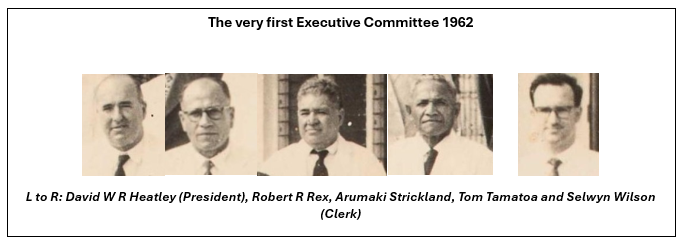
April 1962 An Executive Committee was established consisting of three elected Members of Assembly and the Resident
Commissioner as President.
August 1962 The member for Vaiea (Talaiti Posini) on behalf of all announced that they have elected Robert R Rex (Member for Alofi South), Tamatoa Tom (Member for Tuapa), and Arumaki Strickland (Member for Alofi North), together with the President to form the Executive Committee. 22-23 August 1962. Note: Membership was increased to four elected Members of the Assembly in 1966.
Lorem ipsum dolor sit amet, consectetur adipiscing elit. Ut elit tellus, luctus nec ullamcorper mattis, pulvinar dapibus leo.
1966 Partial introduction of the Member System of Government (a form of government which fall short of full Cabinet Government). Under this system, the Resident Commissioner delegated some of his powers and functions to the elected Members of the Assembly in the Executive Committee, both on a collective and an individual Member basis. Niue’s first political leader (Hon. Robert Richmond Rex) was elected by the Assembly from among its members and designated as Leader of Government Business.
1st November The full Member System of Government was introduced and the Resident Commissioner delegated responsibility over all Departments of
1968 Government to the Executive Committee and the elected Members. This development was a significant step towards plans of self government, as it allowed the locally elected members of the Executive Committee to demonstrate their ability to manage the affairs of Niue independently.
The Resident Commissioner’s address to the Assembly a month earlier stated:
“This gradual shifting of responsibility for policy making and administration will require a changing approach in me, too, the Resident Commissioner. It will be my job to progressively withdraw from my existing complete involvement in day-to-day administration, and at the same time to guide, advise and assist the members of the Executive Committee of this Assembly to assume a much fuller and more positive role in the management of the affairs of Niue.”
The introduction of the full member system and its consolidation period is a step in the constitutional progress of the island.
Limited member system of government started in 1966. The resident commissioner delegates his powers and functions to the elected Members of the Assembly in the Executive Committee. Niue’s first political leader was elected by the Assembly from its members and designated as Leader of Government Business.
New system allocation of portfolio:
Hon. R. R. Rex (Member for Alofi South) and Leader of Government Business
– Member for Works (including Electricity and Airport)
– Member for Agriculture (including Fisheries and Forestry)
– Member for Economic Development and Marketing
– Member for Government Administration (including Village, Government and Community Development
Hon. Pulefolau Talipule (Member for Mutalau)
– Member for Education
– Member for Health
Hon. Siakisoni
– Member for Police (including Prison, Transport, Immigration and Emigration
– Member for Justice (including Lands, Surveys and Registries
Hon. Arumanki Strickland (Member for Alofi North)
– Member for Post Office
– Member for Radio (including Telephones
Powers he cannot yet delegate to the members of the new system:
Defense, external affairs; to the title of Crown to any land, expenditure of all public money will remain in Resident Commissioners control.
June 1972 The United Nations Mission visited Niue as part of the international body’s efforts to assist non-self-governing territories in determining their political future. The visit marks a significant overview of Niue as a dependent territory still under New Zealand’s administration. Niue with a population of 4800+ people pursued in maintaining a unique relationship with New Zealand rather than opting for full independence. The choice reflects the own desire of the Niue Peoples to maintain close ties with New Zealand in areas of defense, external affairs and economic support.
1972 Responsibility for the executive government of Niue was transferred from the Resident Commissioner to the Executive Committee and the four elected Members as a matter of right instead of by delegation as had been the case since 1966 (partial) and 1968 (total). Also, the Resident Commissioner from this point no longer held any powers of veto either in the Assembly or in the Executive Committee.
September 1974 Referendum was held to ensure that Niue people exercised their right to self-determination freely.
The outcome of the referendum notes that the people voted, by a substantial majority, for self-government in free association with New Zealand based on the Constitution and the Niue Constitution Act, 1974.
Of the 1, 384 people voted, 887 (65.40%) voted in favor, 469 (34.60%) voted against, and 28 votes were invalid. Niue’s total population was 3,992, (2,005 males and 1987 frmales) with 107 babies born and there were 1,432 registered voters on the electoral roll.
19 October 1974 Niue attained the status of Self Government in Free Association with New Zealand and brought into force the Niue Constitution Act 1974.
Cabinet 1974
Hon. Robert Richmond Rex, OBE (Member for Alofi South and Premier of Niue)
Portfolio: Government Administration, Finance, Revenue. Customs, and Shipping and Trade.
Hon. Dr Enetama Lipitoa (Member for Namukulu and Cabinet Minister)
Portfolio: Health, Justice, Lands & Survey, Postal Services, and Radio
Hon. Frank Fakaotimanava Lui (member for Alofi North and Cabinet Minister
Portfolio: Public Works, Police, Prison, Transport, Immigration and Emigration
Hon Mititaiaimene Young Vivian (Member for Hakupu and Cabinet Minister)
Portfolio: Agriculture, Education, Economic Development and Tourism
Members of the Legislative Assembly 1974
Frank Fakaotimanava Lui (Alofi North)
Elesoni Togiahetule (Makefu)
Pihigia Maki (Tuapa)
Dr Enetama Lipitoa (Namukulu)
Poepata Limatau (Hikutavake)
Liumaihetau Muimatagi (Toi)
Toni Kalauni (Mutalau)
Togiatama Togiavalu (Lakepa)
Sipeli Simose (Liku)
Mititaiagimene Young Vivian (Hakupu)
Talaiti Posini (Vaiea)
Pita Halo (Avatele)
Ikifotu Manamana (Tamakautoga)
Robert Richmond Rex, OBE (Alofi South)
Speaker Hon Sam Pata Emani Tagelagi
Clerk to Assembly 1974 Charles Ford Hukui
Secretary to Government 1974 Terry Magaoga Chapman
NZ Resident Commissioner C. A. Roberts